The Psychology Behind Why Brides Say “Yes” to a Dress

There is a moment that every experienced bridal consultant knows. The bride arrives having done three months of research. She has screenshots organised by silhouette. She has used the word ‘minimalist’ several times. She tries on the minimalist dress first, and it is fine — genuinely, objectively fine. Then, somewhere in the appointment, the consultant hands her something she did not ask for. Something with detail, or volume, or a quality of movement she had not considered. She puts it on. She looks in the mirror. And she starts to cry.
That moment is not about the dress. Not really.
What happens in a bridal appointment is one of the more psychologically complex buying experiences in retail. The product is expensive, the occasion is singular, and the emotional stakes are higher than in almost any other transaction. Understanding what is actually driving the wedding dress decision — not the silhouette preference, but the emotional architecture underneath it — is what separates a good boutique from a genuinely memorable one. And it is what a serious wedding dress supplier has to understand in order to serve both.
The Bridal Buying Journey at a Glance
Before getting into the psychology section by section, it is worth mapping the emotional stages of a bridal appointment. These are not the stages a bride would describe if you asked her. They are the stages a perceptive consultant observes:
| Stage | What the Bride Experiences | What It Means for the Boutique |
|---|---|---|
| Before the appointment | She has done months of research. She has screenshots, a mood board, and a word she keeps using — 'minimalist', 'romantic', 'elegant'. She thinks she knows what she wants. | The stated preference often diverges from the emotional preference. The research is intellectual. The decision will be emotional. |
| First five minutes | She is on guard. She does not know the consultant yet. She is protecting herself from being sold something she has not chosen. | The appointment opens before the dresses come out. How a consultant listens in the first five minutes determines whether the bride stays open or closes down. |
| The first try-on | She is calibrating. She does not know what 'the feeling' is yet because she has not felt it. The first dress gives her a baseline, not an answer. | The first dress rarely closes. Its job is to open the appointment — to give the bride something to react to. |
| The moment | Something shifts. Her posture changes before she says anything. The room gets quieter. She looks at herself differently. | This is the decision. It is physical before it is verbal. An experienced consultant sees it before the bride has registered it. |
| After the appointment | She lives with it. She describes the experience to other people. She either confirms it or starts to question it. | The quality of the appointment determines which direction this goes. A bride who felt genuinely understood confirms. One who felt sold hesitates. |
Each stage has a different emotional texture. A boutique that reads all five — and knows what to do at each of them — closes more appointments than one that manages only the product side of the conversation.
The Bride Is Not Shopping for a Dress
She thinks she is. On the surface, the bridal appointment looks like any other purchase: a customer with a budget, a preference, and a problem to solve. Find the dress, buy the dress, done.
But the psychological reality is considerably more complex. The decision a bride is making is not primarily about the object — the fabric, the boning, the train. It is about how she wants to exist in the memory of the people she loves most. Which version of herself she is willing to commit to, on camera, permanently. Who she is on the most documented day of her life.
That is an enormous decision. And it is almost never consciously articulated.
Most brides could not tell you that this is what the appointment is actually about. They are describing necklines and asking about hem lengths and wondering whether the style will work in the venue. But underneath all of it, the question they are answering is: Is this who I want to be? The dress that gets the yes is the one that answers that question correctly.
This is why bridal buying psychology is so different from almost every other retail category. The product has almost nothing to do with it, and everything to do with it, simultaneously.
The Identity Question Every Bride Is Actually Answering
Each bride working her way through a bridal appointment is, at some level, negotiating an identity question. The question varies slightly by person, but it tends to take one of a handful of forms.
Some brides are reconciling who they are day-to-day with who they want to be perceived as on this particular occasion. The woman who wears trainers and almost never dresses up is trying to find a dress that allows her to be formal without feeling like she is wearing a costume. She needs to recognise herself in the mirror. The woman who is always the most dressed person in any room is looking for something that finally matches the version of herself she has always carried internally. She needs the outside to catch up with the inside.
Some brides are negotiating between their own aesthetic and the expectations of the people in the room with them. The appointment is ostensibly about her dress. But the mother of the bride has a view. So does the sister. The maid of honour already has strong feelings about sleeve options. The decision about which dress gets the yes is not made in a vacuum — it is made in the middle of a quiet, ongoing negotiation, and the bride is simultaneously managing her own emotional response and everyone else’s.
Some brides are working through something harder: grief, or complicated family dynamics, or the weight of a significant life change they have not quite metabolised yet. The wedding is a threshold. The dress is the outfit she chooses for crossing it.
A boutique that understands why brides choose certain wedding dresses at this level is not selling fabric. It is facilitating an identity decision of considerable personal significance. The consultant who reads this correctly does not need to close the sale. The sale closes itself.
Why the First Dress Is Almost Never the One
Ask any experienced bridal consultant and they will tell you the same thing: the first dress is almost never the one. Not because it is wrong. Because the bride has not yet calibrated her emotional response to what she is looking at. She does not have contrast. She has not been in enough dresses to know what ‘the feeling’ is, because she has not felt it yet.
The appointment is a process of elimination that functions less like a checklist and more like tuning a radio. The bride is scanning through frequencies — a different silhouette, a different fabric weight, a different way a neckline sits against her collarbone — until she lands on one that produces something different from the rest. The others may be genuinely beautiful. This one feels right. The difference between beautiful and right is the entire psychology of the bridal decision, and the two things are not the same.
This is why consultants who listen to what a bride says she wants, but also watch how she reacts when she says it, close more appointments than those who take the brief at face value. The bride who says she wants something simple may be asking for simplicity because she is afraid of standing out and does not quite trust herself to pull off something more visible. Give her the simpler dress first — and then, once she has relaxed into the appointment, show her the one with the detail. She may discover that what she wanted was permission, not restraint.
The gap between the stated preference and the emotional preference is where most bridal buying decisions actually live. A good boutique knows how to move a bride between the two without ever making her feel led.
The Moment the Decision Actually Happens
There is a specific moment in most bridal appointments when the decision is made — and it is not always the moment the bride says yes.
Sometimes it is physical. The dress goes on and the posture changes before a word is said. The bride stands differently — taller, or stiller, or with a quality of attention in the body that was not there a dress ago. An experienced consultant will see this before the bride has registered it herself. The bride is still looking at the mirror critically, still cataloguing features, still performing the act of evaluation. But something underneath the performance has already decided.
Sometimes it is what does not happen. There is a quietness in the room when the right dress is on — the people who have been commenting on every other dress say nothing for a beat too long. That silence is the room feeling something. It is more diagnostic than any opinion.
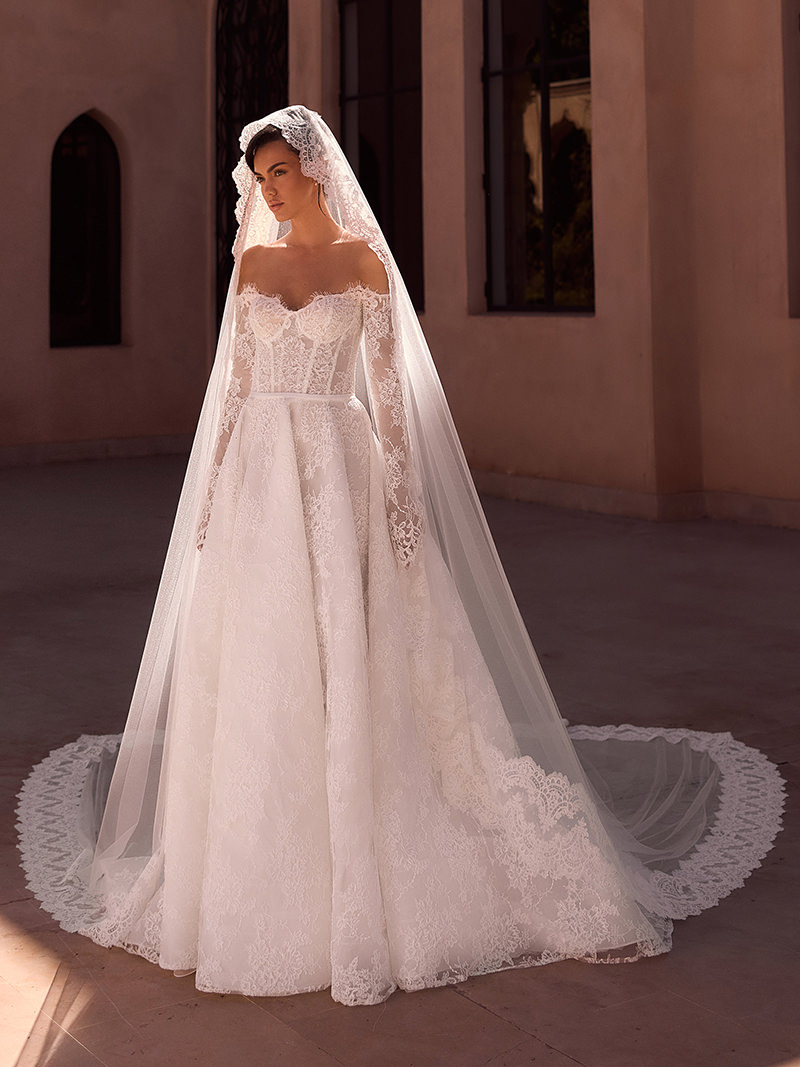
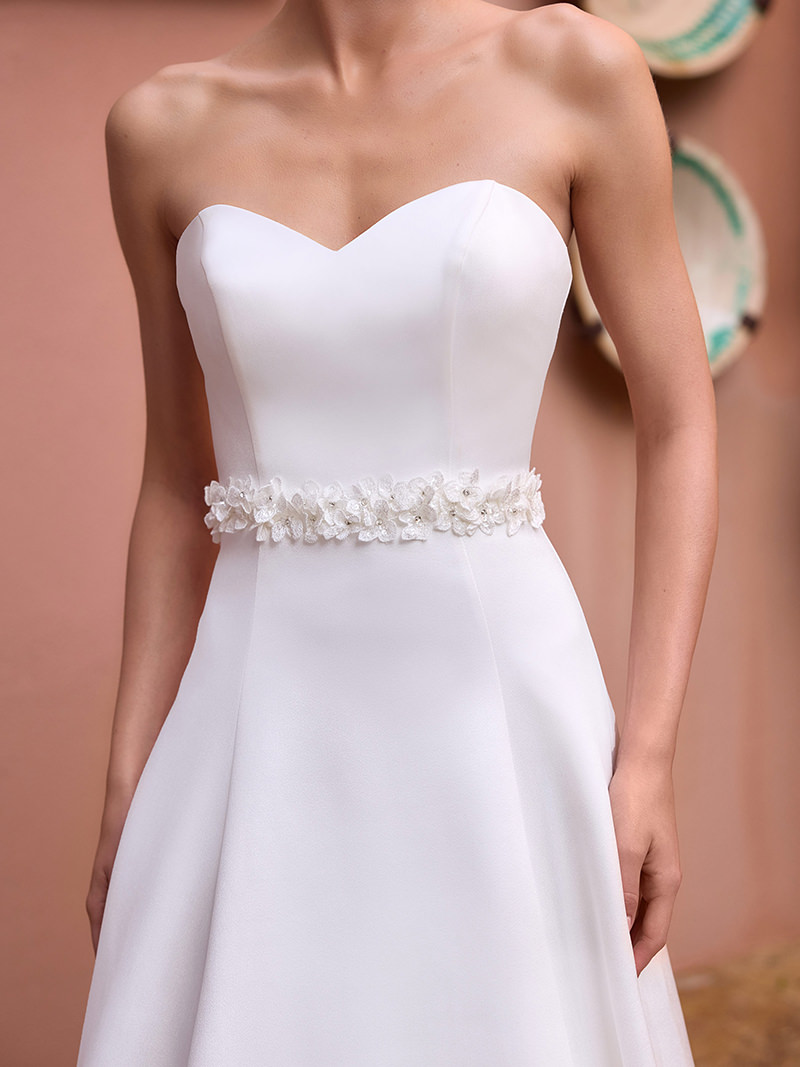
Sometimes it arrives through an object: a veil placed carefully on the right spot, a particular piece of jewellery, the addition of a strap or a sash that completes a picture that was almost complete. The decision was already 90 per cent made; the accessory resolved the remaining ambiguity. This is one of the less discussed reasons why the boutique’s accessories selection matters — not as upsell, but as the thing that occasionally tips a bride from almost to yes.
What is never the trigger is rational analysis. Brides do not buy dresses because the cost-per-wear calculation is favourable or because the fabric technically suits the season. They buy them because something in the appointment produced an emotional response they could not argue themselves out of. Every other consideration follows from that.
Who Else Is in the Room — and Why It Complicates Everything
The people a bride brings to her appointment are not neutral observers.
Every person in the group has a relationship with the bride, a set of expectations about what she should look like, and an emotional investment in the day that often predates the engagement by years. The mother who cries at a dress that is not the one — and does not cry at the one that is. The friend who cannot stop saying ‘you could totally pull it off’ about a style the bride is clearly uncomfortable in. The sister who is managing her own complex feelings about the wedding through her feedback on the neckline.
A bride making this decision alone would be making it very differently. With a group, she is managing all of it simultaneously: her own response to the dress, the room’s response, the desire not to disappoint anyone, and the deeply human need to feel that the people she loves most approve of the choice she is making. Sometimes those things align. Often they do not.
This is why second appointments happen. The bride who comes in with the full group on Saturday and books again on Tuesday with only one person — that is a bride who knew what she wanted but needed space to confirm it without an audience. The boutique that offers that space, and the consultant who creates it naturally rather than by policy, builds the kind of trust that produces a clear decision instead of an ongoing search.
It is also, incidentally, why the ‘yes’ moment in a group appointment carries so much weight when it does happen. When the room reacts to the same dress without being asked — when the mother and the sister and the best friend all register something at the same time without looking at each other first — the bride feels it. That moment of unanimous, unsolicited emotional agreement is frequently what removes the last hesitation.
What This Means for Boutiques — and for Their Wedding Dress Supplier
Understanding the bridal buying psychology changes how a boutique operates in ways that are both subtle and significant.
It changes the questions asked at the start of the appointment. Not just ‘what style are you thinking?’ but ‘what do you want to feel like?’ Not ‘what is your budget?’ first, but ‘who is coming with you?’ — because knowing the room before the bride arrives changes how the appointment is set up.
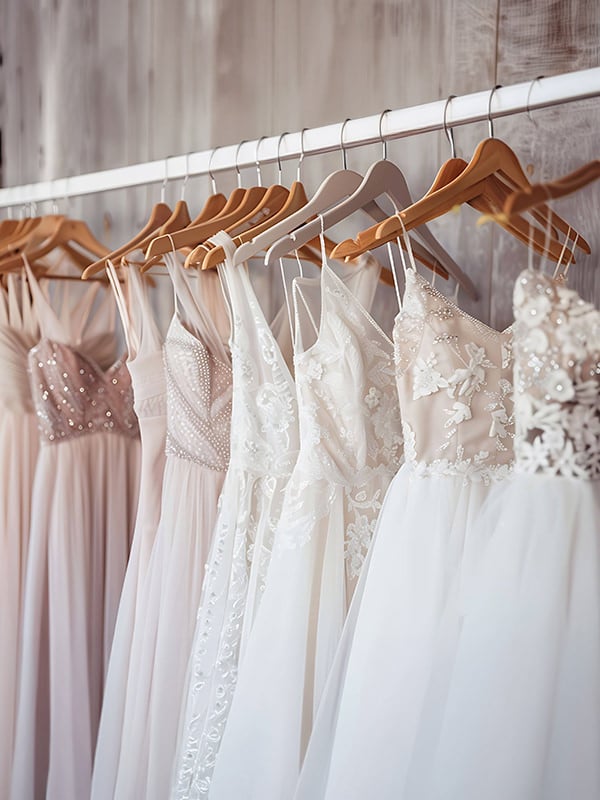
It changes how the rail is curated before she arrives. A consultant who has heard from the bride in advance — or who reads the appointment correctly in the first five minutes — does not put every available style on the rail. She puts the ones that will produce contrast, that will help the bride calibrate her response, that will create the conditions for the moment rather than simply offering options.
It changes how accessories are introduced. Not as an afterthought, and not at the beginning. The veil, the sash, the strap — these are tools for resolving ambiguity, and they are most effective at the point where the bride is 90 per cent decided and cannot find the last 10 per cent.
But all of this — every nuance of appointment craft — depends on what the wedding dress supplier provides. A boutique cannot create the conditions for an emotional decision if the dress that produced the emotional response is out of stock. It cannot serve the bride who is a size 18 if the range runs to a 16. It cannot close the appointment for the bride who changes her mind if reordering the dress she decided against three weeks later takes eight weeks.
The supplier is not present in the appointment. But the supplier’s inventory, range, and reliability determine what is possible in that appointment, more directly than most boutiques think about consciously.
| Bianco Evento as a Wedding Dress Supplier | What This Means for Your Boutique |
|---|---|
| Experience | 17 years as a wholesale bridal and occasion-wear supplier |
| Boutique partners | 5,000+ boutiques across 80+ countries |
| Stock availability | 95% of items in stock at any time |
| Silhouette range | Long gowns, short dresses, A-lines, ballgowns, mermaid styles, jumpsuits, maternity |
| Minimum order | None — boutiques can order from a single piece |
| Size range | Extended size range available across the collection |
| Design and production | EU-designed, manufactured in Barcelona |
| Quality certification | Hohenstein textile testing institute certified |
| Industry recognition | EBW Best Accessories Supplier Award 2026 |
Bianco Evento’s wholesale model — no minimum order, 95% in-stock rate, a range that spans every major silhouette — is designed for exactly this dynamic. The boutique’s job is the appointment. The wedding dress supplier’s job is to ensure the boutique is never limited by what’s available.
The Dress That Travels
There is one last psychological observation worth making, and it is the one that has the most commercial consequence for a boutique.
The dress a bride chooses has a life far beyond the day itself. It lives in the photographs. It appears in a frame on a wall for decades. It is described to other people — future brides, friends who are newly engaged — using whatever words were in the room when the decision was made. ‘I walked out of the appointment feeling like I’d always known it was the one’ is a sentence that gets repeated. So is ‘I felt pressured into it’.
A bride who was genuinely understood in her appointment — who was guided by a consultant who read the room rather than the brief — and who left with a gown that answered the identity question she was actually asking — that bride talks about the boutique. She sends the next bride there with a specific recommendation. She becomes the boutique’s most effective marketing without the boutique spending anything to make it happen.
The bridal buying decision is more personal, more emotionally loaded, and more psychologically complex than almost any other retail purchase. The boutiques that understand this, and the wedding dress suppliers who give them the range and reliability to serve it well, are the ones that build businesses that do not need to advertise heavily. The brides do it for them.
Frequently Asked Questions
Why do brides take so long to decide on a wedding dress?
Because they are not just choosing a dress. They are working through an identity question — how they want to be seen, how they want to feel, and whether the version of themselves in the mirror matches the version they carry internally. That question takes time to answer, and the answer often does not arrive from looking at more photographs or visiting more boutiques. It arrives in a specific appointment, with a specific dress, when something shifts in the room.
Why do brides often choose a dress they didn't originally plan to try?
Because stated preferences and emotional preferences are frequently different things. A bride who says she wants something minimalist often means she wants to feel uncontrived — and a dress with considered detail might produce exactly that feeling if the detail reads as intentional rather than decorative. An experienced consultant understands that the brief is a starting point, not a limit. The dress she hands over ‘just to try’ is rarely accidental.
What is the 'moment' in a bridal appointment?
It is the point — usually physical before it is verbal — when the bride’s relationship with the mirror changes. Her posture shifts. The room gets quieter. The people who have been commenting on every previous dress say nothing. An experienced consultant recognises it before the bride has processed it herself. Everything in the appointment — the curation of the rail, the sequence of styles, the timing of the accessories — is designed to create the conditions for this moment. The moment is the entire purpose of a bridal appointment.
How does a wedding dress supplier affect the emotional experience in a boutique?
More directly than most people consider consciously. If the dress that produced the emotional response is out of stock, the moment is lost. If the size range does not serve the bride in the room, the appointment cannot close. If reordering takes eight weeks, a bride who changed her mind after saying yes cannot be recovered. A wedding dress supplier with 95% stock availability, a broad size range, and no minimum order protects the boutique’s ability to have the appointment the bride came in for — and to resolve it properly, whatever direction it takes.
Why do some brides doubt their decision after saying yes?
Usually one of three reasons. The room’s reaction did not match hers — the people she brought felt differently, and she is now reconciling her response with theirs. The appointment dynamic produced the yes before she had fully reached it herself — she felt sold rather than certain. Or time has simply changed the emotional conditions: what felt right in the heightened atmosphere of the appointment feels less definitive a week later. Good boutiques reduce the third by ensuring the first yes is genuinely felt — not pressed for. The difference is usually in how the appointment ends, not how it begins.
Partner with a Wedding Dress Supplier That Understands What Boutiques Actually Need
A great bridal appointment is built on psychology, craft, and the trust a bride places in the boutique she chooses to walk into. What makes that appointment possible is range, reliability, and a wedding dress supplier who understands that the boutique’s job is the appointment — and who makes sure the boutique is never limited by what is available.
Bianco Evento has served boutiques across 80+ countries for 17 years, with 95% in-stock availability, no minimum order, and a collection that spans every major silhouette, fabric, and occasion type. EU-designed. Barcelona-manufactured. Independently certified. EBW Best Accessories Supplier 2026.